Business Class vs First Class: Which Is Actually Worth It in 2026?
You’ve decided the economy isn’t happening on this trip. Smart. But now you’re staring down a booking page, wondering, Do I go business class or splurge all the way on first? The price gap can be thousands of dollars—so the answer actually matters.
Here’s the honest breakdown, no fluff. Business Class vs First Class: Which Is Actually Worth It?
What’s the Actual Difference Between Business Class and First Class?
Let’s clear something up first: on most US domestic flights, there’s no “true” first class at all. What American Airlines calls first class on domestic routes is essentially just a wider seat with a free drink. That’s not what we’re talking about here.
We’re talking about international long-haul flights—New York to Paris, LA to Dubai, Chicago to Tokyo—where the gap between business and first class is very, very real.
The simplest way to think about it: business class is built for comfort and productivity; first class is built for pure indulgence. Both are enormous upgrades over the economy. But the experience diverges sharply once you start looking at the details.
Seats & Privacy: A Pod vs. a Personal Suite

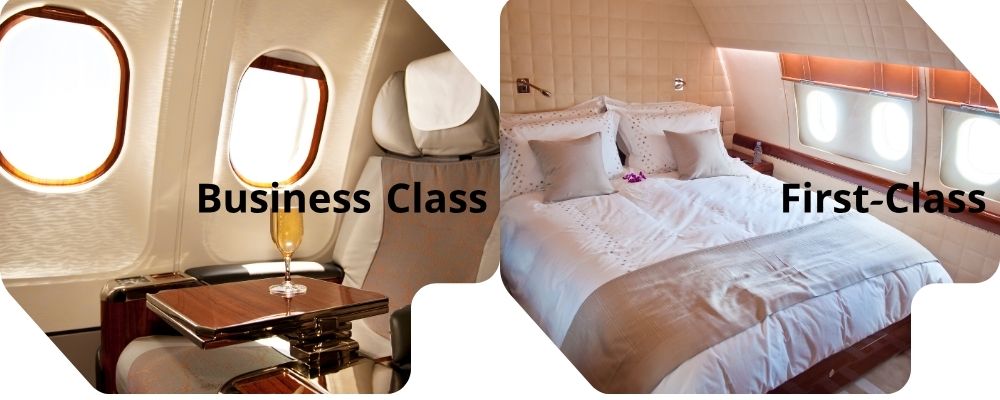
Business class seats on modern long-haul flights are genuinely impressive. You get a fully lie-flat bed (usually 6–7 feet), direct aisle access on better airlines, a privacy divider, and your own storage space. Qatar Airways’ QSuite, Emirates Business, and Singapore Airlines Business are the gold standard here—these products would have been called first class a decade ago.
First Class is a completely different world. Think private suites with closing doors, a standalone seat and a separate ottoman or bed surface, memory foam mattresses with full turn-down service, and often enough room to stand up and stretch. On Emirates’ A380, first class suites have sliding doors, a vanity mirror, mood lighting you control, and a wardrobe. Some airlines — notably Etihad’s The Residence — offer a private bedroom, living room, and shower on a single ticket.
Verdict on seats: Business class on top-tier airlines already gives you a bed and privacy. First class gives you an actual suite. If sleep quality and personal space are your priority, first class wins — but business class is no longer a consolation prize.
Business Class vs First Class
Service: Attentive vs. Genuinely Concierge-Level
In business class, cabin crew are professional and attentive — but they’re managing 30–50 passengers. Service is structured, responsive, and excellent by most standards. You’ll get a welcome drink, a warm towel, and multi-course dining with real cutlery.
First class flips the entire model. Crew-to-passenger ratios drop dramatically — sometimes as low as one crew member per two or three passengers. Staff often greet you by name before takeoff. Your coat is hung, your dining preferences are noted, and your meal is brought out on your schedule, not a preset timeline. On Air France’s La Première, the chef walks through the cabin to discuss the menu personally.
It’s the difference between a great restaurant and a private dinner party where you’re the only guest.
Food & Drink: Great vs. Michelin-Adjacent
Both classes are worlds above economy food. In business class, you’ll get proper multi-course meals, real champagne or wine, and quality glassware. Many airlines bring in consulting chefs for business cabin menus.
First class takes dining into genuinely fine-restaurant territory. Caviar service at 35,000 feet is not unusual. On Lufthansa First, you can pre-order from a detailed à la carte menu weeks before your flight. On Singapore Airlines First, the dining experience is modeled after their “Book the Cook” program with restaurant-grade plating and tableside service.
Airport Lounges: Good vs. Extraordinary
Both classes typically include lounge access — but the lounges themselves are very different.
Business class lounges are excellent: comfortable seating, shower suites, a full bar, hot food buffets, workspaces, and quiet areas. Most major international airports have very solid business lounges.
First-class lounges are a different tier entirely. The Air France La Première lounge at Paris CDG has a restaurant with table-service dishes by Alain Ducasse; the business lounge has a self-serve buffet. Emirates’ First Class Lounges in Dubai offer a spa, à la carte dining, and dedicated seating for every passenger. Some first class passengers receive chauffeur pick-up from their home and a personal escort to the aircraft—no security queues, no crowds.
The Price Reality: What Are You Actually Paying?
Here’s where things get uncomfortable. Let’s look at real 2026 fares for a benchmark route like New York to London round-trip:
| Cabin | Typical Roundtrip Fare |
|---|---|
| Economy | $600 – $1,200 |
| Business Class | $3,000 – $5,000 |
| First Class | $10,000 – $20,000+ |
On some routes, the gap is smaller. Emirates JFK–Dubai business class runs around $3,700 roundtrip; first class starts around $5,000 on the same flight. Lufthansa JFK–Frankfurt business class can be found around $1,300, while Lufthansa First starts at $11,000. That’s not a typo.
For most travelers, the question isn’t just “Which is better?”—it’s “Is first class $7,000 to $15,000 better than business class?”
So Which Should You Actually Book?
Here’s the honest answer, broken down by situation:
Book Business Class if:
- You want a lie-flat bed and a massive upgrade over economy at a fraction of first-class prices
- You’re traveling for work or mixing business with leisure
- You’re flying routes where top-tier business products (Qatar QSuite, Emirates Business, Singapore Business) are available—these deliver 85–90% of the first-class experience at a fraction of the cost
- You plan to sleep most of the flight and don’t need extras like a shower mid-air
Book First Class if:
- This is a once-in-a-lifetime trip—honeymoon, anniversary, milestone birthday
- You’re flying overnight on an ultra-long route (New York to Singapore, LA to Dubai) where every hour of quality sleep matters
- You genuinely want the full suite, shower spa, chauffeur, and concierge experience as part of the travel memory
- You’ve accumulated miles and can use points to close the price gap significantly
The sweet spot most luxury travelers miss: top-tier business class products—especially Qatar QSuite, Emirates Business on the A380, and Singapore Airlines Business—are so good that most travelers cannot honestly justify first class at cash prices. Where first class earns its keep is on specific airlines (Emirates, Lufthansa, Air France, Singapore) on ultra-long routes, and specifically for special-occasion trips where the entire experience is the point.
Airlines That Still Offer True First Class (2026)
Not every airline even has a first-class cabin anymore. As of 2026, airlines with a genuine first-class product above business include:
- Emirates—widely considered the benchmark; A380 shower spa is iconic
- Singapore Airlines — legendary service; Suites Class is its own tier above first
- Lufthansa — ultra-exclusive First Class Terminal in Frankfurt; 8 seats on select flights
- Air France La Première — one of the most refined cabin experiences in aviation
- Japan Airlines & ANA — exceptional first class products, beloved by frequent flyers
- Cathay Pacific — strong first class, though their business product is also world-class
- Korean Air — solid first class, particularly on long-haul routes
Note: Qatar Airways and Etihad no longer operate a traditional first class on most routes—their business products (QSuite and Business Studio) have replaced it, which tells you everything about how good those business cabins are.
The Miles Angle: When First Class Becomes Attainable
One scenario where first class becomes genuinely worth considering: using points and miles.
With the right credit card strategy and airline loyalty programs, first-class tickets that cost $15,000+ in cash can be redeemed for 70,000–150,000 miles round-trip, depending on the program. That changes the math completely.
If you’re building a miles strategy specifically to fly first class, programs like ANA Mileage Club, Air Canada Aeroplan, and Virgin Atlantic Flying Club consistently offer the best redemption rates for premium cabin partners.
Final Verdict
For most travelers — even luxury travelers — business class on a top-tier airline is the sweet spot. You get the lie-flat bed, lounge access, quality dining, and a genuinely memorable experience without paying the first-class premium that can exceed $15,000 roundtrip.
First class earns its price tag for honeymoons, major anniversaries, or ultra-long routes where the extra privacy, suite doors, and concierge experience are worth every cent. It’s not better in an objective sense — it’s different, in the way a private villa is different from a five-star hotel. Both are extraordinary. One just happens to cost three to four times more.
The real question isn’t which is better. It’s which is better for you on this trip, at this moment in your life?
Ready to book your next premium flight? Search and compare business and first class fares on Expedia — you can filter by cabin class, airline, and price to find the right upgrade for your next trip.
Related posts you’ll love: