20 Luxury Travel Tips Every First-Class Traveler Needs to Know in 2026
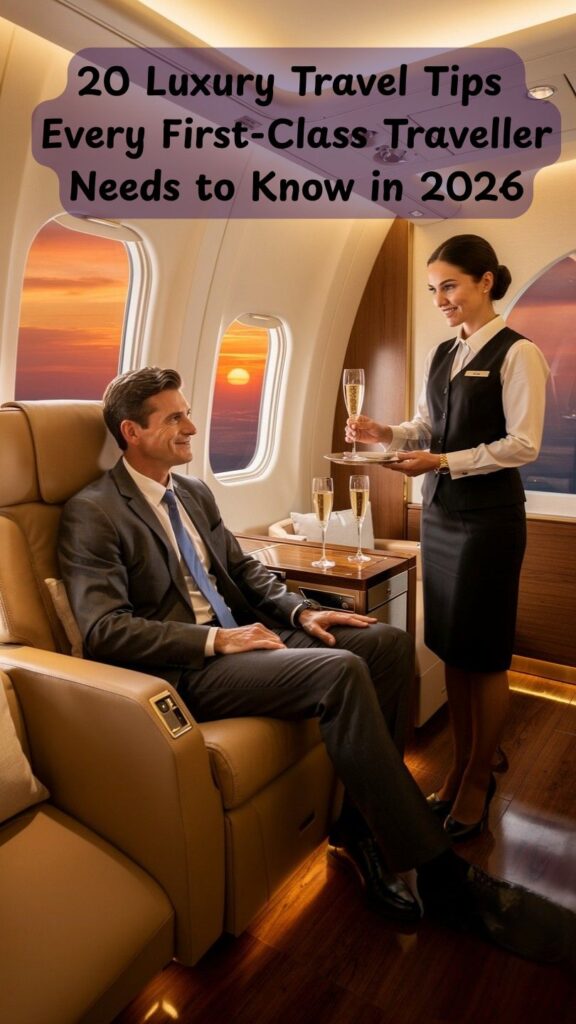
There is a version of luxury travel that looks expensive and feels ordinary. The five-star hotel that photographs beautifully but has indifferent service. The first-class seat that costs three times as much as business class but delivers 30% more. The guided tour that takes you to the same spots as every other tourist, just with slightly better canapés.
And then there is the other kind.
The kind where a museum docent unlocks a room that isn’t on the public map. Your hotel suite is upgraded before you arrive because someone made a call, so the flight is genuinely the beginning of the experience rather than the inconvenience that precedes it.
The difference between the two is not always money. It is almost always knowledge.
These are the 20 luxury travel tips that separate the first-time luxury traveler from the one who does it effortlessly—gathered from the most informed voices in the industry in 2026.
Read More Valuable Articles:
Best Time to Book International Flights from USA (2026 Guide to Save Money)
Best Luxury River Cruises in Europe for 2026 (Worth Every Penny)
20 Luxury Travel Tips
Planning: The Decisions That Determine Everything
1. Book 6–12 Months Out—Non-Negotiable for the Best Experiences
The timing varies: ultra-luxury properties require 8–12 months’ booking, popular peak-season travel needs 6–8 months, and standard luxury accommodations need 4–6 months. This is not a soft recommendation. The world’s finest suite at Aman Tokyo, the private villa at Nihi Sumba, and the Chef’s Table at a Michelin three-star—these are not available to people who decide to travel in three weeks.
The days of last-minute luxury are fading. To secure the top suites, expert guides, and direct flights, plan at least six to nine months—longer for high-season Europe or bucket-list safaris. Precision planning isn’t restrictive; it’s what ensures freedom when it matters most.
For travelzvibe readers: If you’re planning a 2026 summer trip to Europe and haven’t booked yet, act now. If you’re planning for 2027, start planning by September 2026.
2. Shoulder Season Is Where Luxury Actually Lives
Peak season doesn’t always mean peak experience. Italy in May, Europe in September, the Caribbean in early December: shoulder seasons offer gentler crowds, genuine hospitality, and often better value without sacrificing luxury.
The practical impact: restaurant reservations open up, museum visits feel like private tours, and hotel staff have time to actually care for you rather than process you. The Amalfi Coast in late September, after the summer crowds thin and the light turns golden, is a fundamentally different — and better — experience than the same coast in August.
3. Use a Luxury Travel Advisor for Complex Trips
A seasoned travel advisor’s global network can secure what algorithms can’t—invitation-only tastings, coveted suite upgrades, after-hours museum access, or private yacht charters. Real connections yield real privileges.
Professional advisors provide significant time savings through curated options, insider access to exclusive perks (room upgrades, resort credits, VIP treatment), problem-solving advocacy during travel, and often equivalent or better pricing due to advisor-exclusive rates and value-added amenities.
For a $20,000 trip, the advisor fee (or commissions paid by the hotel) is trivial compared to the value of a suite upgrade, complimentary breakfast, and a private experience arranged before you arrive.
[AFFILIATE LINK: Plan your luxury trip with a Travelovin advisor]
4. Watch for Airline Business and First-Class Sales—They’re More Common Than You Think
British Airways sometimes launches promotions that allow travelers to book a Business Class return ticket while flying one leg in First Class. Qatar Airways regularly introduces highly attractive companion deals that effectively allow a second traveler to fly for free when one business-class ticket is purchased. Although these sales are time-limited and often market-specific, they can reduce the cost of long-haul luxury travel dramatically.
Subscribe to airline newsletters for Qatar, Emirates, British Airways, Singapore Airlines, and ANA. When the sale email arrives, you need to be ready to book within hours. These fares disappear fast.
[AFFILIATE LINK: Search and compare business class flights — Expedia]
5. Plan Around 2026’s Major Events—or Deliberately Avoid Them
In 2026, major global events are shaping travel more than ever. With North America hosting the FIFA World Cup and the Winter Olympics taking place in Milan, many travelers will be planning entire journeys around these once-in-a-generation moments. Sporting events, alongside cultural milestones, fashion weeks, art fairs, and landmark celebrations, are increasingly dictating not just where people go, but when they travel.
The corollary: if you’re not going to the event, avoid these destinations during peak event periods. Hotels around FIFA World Cup venues in the US, Canada, and Mexico will be fully booked and significantly more expensive from June to July 2026. Milan during the Winter Olympics will be similarly constrained.
Flights: How to Fly Luxury Without Flying Blind
6. Always Pack a Luxury Carry-On Kit
Pack a luxury travel essentials kit: include high-quality skincare, noise-cancelling headphones, a silk eye mask, and a cashmere blanket in your hand luggage for maximum comfort during flights.
Even in First Class, the airline-provided amenities are generic by definition. The travelers who arrive fresh are the ones who brought their own Bose QC45 or Sony XM5 headphones, a silk sleep mask (the provided ones bunch), a natural facial mist, compression socks for flights over 8 hours, and a cashmere travel blanket that also doubles as a wrap at your destination.
7. Use Lounge Access Strategically—Not Just for Free Food
Airport lounges are not just about eating and drinking before your flight. The best ones—Qatar Airways Al Mourjan in Doha, Singapore Airlines SilverKris in Singapore, Cathay Pacific The Pier in Hong Kong, and Qantas First Class Lounge in Sydney—are destination experiences in themselves, with shower suites, à la carte dining, day beds, and professional spa treatments.
Lounge access provides a more relaxed environment, complimentary food and drinks, and often includes fast-track security lanes. If your credit card or ticket doesn’t include lounge access, Priority Pass and Dragonpass both offer independent access at most major airports globally.
Get Priority Pass lounge access.
8. Choose Your Seat With Architecture in Mind
On wide-body aircraft like the Boeing 777 and Airbus A380, seat architecture varies dramatically across airlines—and even within the same airline’s different cabin configurations. On some aircraft, window business class seats offer complete privacy and direct aisle access. On others, the same class have middle seats where you must climb over your neighbor to reach the aisle.
Before booking, check SeatGuru.com for your specific aircraft type and flight number. This takes five minutes, and the difference between a bulkhead window seat and a middle pair seat in the same cabin is the difference between sleeping soundly and arriving exhausted.
Hotels: Getting More Than You Pay For
9. Always Book Direct—or Through Preferred Partners
Hotels offer their best rates, most flexible cancellation terms, and priority upgrade status to guests who book directly rather than through OTAs. However, booking through an American Express Fine Hotels & Resorts, Virtuoso, or Four Seasons Preferred Partner travel advisor often delivers additional perks—complimentary breakfast, resort credits, early check-in — on top of the direct rate.
The combination of direct booking with advisor-added benefits is the most advantageous arrangement available. Never book a luxury hotel through a generic OTA without first checking whether an advisor can match the rate with additional perks.
10. Request Your Upgrade Before You Arrive
Most luxury hotels have a pre-arrival team whose job is to personalize your stay before you check in. An email 48–72 hours before arrival — politely noting your occasion (honeymoon, anniversary, birthday) and any room preferences — is frequently the difference between the assigned room and a complimentary upgrade to the next category.
The language matters: “We’re celebrating our honeymoon and would be grateful for any consideration of a room with a view” works better than “I want an upgrade.” Hotels upgrade guests who feel connected to. Make them feel connected.
11. The Concierge Is More Powerful Than Any App
Travelers want insider access: private visits with historians, chefs, artists, and local creators. Culturally authentic experiences paired with access to local experts create lasting memories beyond hotels and sunsets.
Lifestyle concierges such as Quintessentially open doors to private events, secret tastings, and one-of-a-kind experiences that aren’t advertised anywhere.
Your hotel concierge — at a serious luxury property — has relationships that no travel app can access. The private room in the museum. The dinner reservation at the fully booked restaurant. The local family will cook you lunch in their home. These experiences don’t exist on booking platforms. They exist in the contacts list of a good concierge who has been building relationships for a decade.
Talk to the concierge. Tell them what genuinely excites you. Ask them what they would do if it were their trip. Then listen carefully.
Experiences: What Separates the Memorable From the Forgettable
12. Book Pre-Opening Access to Museums and Monuments
Enter with the clavigero (keeper of the keys) at first light and wander near-empty galleries before Rome wakes. Art and architecture connoisseurs can secure exclusive entry windows and scholar guides, then shape a day of ateliers, cafés, and rooftops that keep the magic flowing long after dawn.
Private pre-opening access to the Louvre, the Vatican Museums, the Uffizi in Florence, or the Acropolis in Athens — arriving before the doors open to the public, with a private scholar-guide and the galleries entirely to yourself — is one of the most transformative experiences available in luxury travel. These arrangements require booking, usually through a specialist tour operator or the hotel concierge.
13. Hire Private Guides Who Are Scholars, Not Just Narrators
The difference between a licensed tour guide and a scholar-guide who has spent 20 years studying a specific collection or site is the difference between being told facts and actually understanding something. Great private guides don’t recite information—they tell stories, answer questions, adjust to your interests, and take you places the group tours never go.
For major cultural sites, ask your hotel concierge to recommend a specific guide by name, with credentials. The best guides at any major destination are fully booked months in advance—another reason why planning 6+ months out matters.
[AFFILIATE LINK: Book expert-led private city tours — GetYourGuide]
14. In 2026, Pursue the Undiscovered Over the Overexposed
There’s a growing fatigue with destinations that feel over-documented and underwhelming in person. In 2026, luxury travelers are choosing places that still feel undiscovered—or at least thoughtfully protected from overexposure. Remote regions, conservation-driven properties, and places that require intention (not algorithms) to find are leading the charge.
The Seychelles is maturing into a refined alternative to the Maldives. Mozambique—with properties like Kisawa Sanctuary—is emerging as the next frontier. In Europe, Comporta in Portugal, 50 kilometers south of Lisbon, past rice paddies and cork forests, has no marina, no casino, and no beach clubs playing commercial music—it is Europe’s best-kept coastal secret.
Being early to an extraordinary destination is one of the genuine privileges of informed luxury travel.
Wellbeing and Practicalities: The Details That Define the Trip
15. Travel Insurance Is Non-Negotiable at This Level of Spend
Comprehensive travel insurance—including “cancel for any reason” protection and medical evacuation—is no longer optional. Think of it as the seatbelt for your journey: you may never need it, but you’ll be grateful it’s there if you do.
Comprehensive insurance should include trip cancellation/interruption coverage (100% of cost), medical emergency coverage including evacuation, baggage loss/delay coverage, cancel-for-any-reason protection (75% reimbursement), and supplier default protection. Purchase within 14 days of initial deposit for maximum benefits.
On a $25,000 trip, travel insurance costs roughly $300–$700. The calculation is not complicated.
Get comprehensive travel insurance — EKTA Insurance.
16. Allow Buffer Time at European Borders in 2026
With Europe’s new Entry/Exit biometric system launching in 2026, plan extra time at Schengen borders while data is captured. Even the best itineraries face delays, detours, and surprises.
The EU’s Entry/Exit System (EES)—now operational—requires biometric data capture (fingerprints and facial image) at first entry for non-EU nationals. First-time captures take longer. Build 30–45 extra minutes into your arrival plans at major European entry points.
17. Pack for the Destination’s Dress Culture, Not Your Own Comfort
European cities require smart casual, dressier than US standards, plus comfortable walking shoes. Tropical resorts call for lightweight fabrics and resort wear. Luxury cruises require formal evening wear and resort casual. Safari adventures need neutral colors, layers, and closed-toe shoes.
Arriving at a Michelin-starred restaurant in Paris in jeans and trainers creates a gap between the experience you wanted and the one you get. The dress code exists not to exclude but to create a shared context. Respecting it signals that you understand and appreciate where you are.
18. Combine Wellness Into the Itinerary, Not as an Afterthought
Health and well-being are at the forefront of travelers’ priorities in 2026 and beyond. These trips combine sustainability with exceptional experiences.
The finest luxury travel experiences in 2026 are those that leave you feeling genuinely restored rather than just entertained. Build spa days, nature immersions, and genuine rest into your itinerary before you leave—not as compensation for an overstuffed schedule but as deliberate pillars of the experience. The guests who return from luxury travel refreshed are the ones who planned for it.
19. Use Technology to Track Fares—But Decide With Human Intelligence
In 2026, the cheapest flights are rarely found by booking late, but by booking smart, early, and with the help of intelligent price-tracking tools. Modern airfare pricing is driven by complex algorithms that respond to demand, historical trends, and real-time market conditions.
Use Google Flights price tracking and Hopper for alerts. But understand that the algorithm optimizes for average outcomes. For specific luxury cabin fares, specific routes, and specific dates, a human who knows the airline’s sales patterns will consistently outperform the algorithm.
20. The Rarest Luxury in 2026 Is Genuine Presence
Smart apps and digital tools are brilliant for planning—but the gestures, insights, and thoughtful care that create emotional resonance come from people. It is these human-led moments—carefully observed, creatively executed, and intuitively timed—that define the journeys travelers remember forever.
The most frequently reported regret among experienced luxury travelers is not where they went or what they spent. It is that they were half-present for it—checking emails at the breakfast table in Positano, photographing the sunset rather than watching it, moving so fast between experiences that none of them landed.
The discipline of putting the phone away. Of being in the room. Of allowing the place to reach you. This is available to every traveller regardless of budget — and it is the one tip that guarantees a better trip, no matter what else you do.
Quick Reference: The Luxury Travel Planning Timeline
| Months Before | Action |
|---|---|
| 12 months | Book ultra-luxury hotels, safaris, bucket-list experiences |
| 9 months | Book flights, especially business/first class on peak routes |
| 6 months | Book fine dining restaurants, private guides, museum access |
| 3 months | Pre-arrival hotel emails, insurance, and visa applications |
| 6 weeks | Confirm all bookings and share the itinerary with the concierge. |
| 2 weeks | Pre-arrival upgrade request email to hotels |
| 48 hours | Check in online, confirm transfers and private tours |